
My Albanian studies
  • Brief History
  • Timeline
    • Pre-History >
      • Balkan pre history
      • The Origin >
        • The Illyrian Emperors >
          • Illyrian weaponry
          • Rulers of Illyria
          • Illyrian Cities
          • Illyrian Tribes
    • Common Era >
      • Byzantine Albania >
        • Middle Ages >
          • Siege of Berat (1455)
          • Under Bulgarian Empire
          • Siege of Berat (1280–81)
          • Battle of Dyrrhachium
          • Kingdom of Albania (medieval)
          • Principality of Arbanon
    • Modern Times >
      • Ottoman Era >
        • Albanian Grand Veziers
        • Battle of Albulena
        • Battle of Kosovo
        • The Great Serbian Myths
      • League of Prizren >
        • Albanian Revolts of 1833–39
        • Revolt of 1432–36
        • Revolt of 1843–44
        • Revolt of 1845
        • Revolts of 1847
        • Revolt 1911
        • Revolt of 1910
        • Revolt 1912
        • Massacre of beys
        • National Awakening
        • Bulgarian Occupation
        • Albanian Independence >
          • Provisional Government
      • Autonomy of Northern Epirus
      • Partition of Albania
      • Autonomous Korca
      • Balkan Wars
      • Treaty of London
      • Italian Protectorate of Albania
      • Republic of Mirdita
      • Republic of Central Albania
      • Principality of Albania
      • Kingdom of Albania
      • Congress of Dibra
      • Congress of Lushnje
      • Albanophobia
      • Communism >
        • Enver Hoxha
        • Labor Party
        • People's Socialist Republic of Albania
        • Politburo of the Labor Party
        • Fall of Communism
      • World War I
      • World War II >
        • Security Battalions
        • Balli Kombetar
        • Ali Demi Battalion
        • National Liberation Movement
        • Italian colonists
      • 97' Anarchy
  • Rivers
  • Regions
    • Albanians of Serbia
    • Albanians of Macedonia
    • Albanians of Montenegro
    • Albanians of Greece
    • Albanians of Kosovo
    • Myzeqeja
    • Laberia
    • Albanian Cities >
      • Ulqin
      • Pej
      • Prishtine
      • Manastir
      • Tivar
      • Korca
      • Gjirokastra
      • Tetov
      • Gostivar
      • Lushnje
      • Lezha
      • Gjakov
      • Kruja
      • Dibra
      • Fieri
      • Saranda
      • Pogradec
      • Podgoric
      • Gilan
      • Ferizaj
      • Elbasan
      • Shkup
      • Ohrid
      • Tepelena
      • Prizren
      • Berat
      • Vlora
      • Shkodra
      • Drenic
      • Mitrovic
      • Kercov
      • Kumanov
      • Tirana
      • Durres
    • Albanian Sanjak
    • Albanian Villayet >
      • Skadar Villayet >
        • Scutari Pashalik
      • Manastir Villayet >
        • Berati Pashalik
      • Kosovo Villayet >
        • Sanjak of Kosova
      • Yanina (Janina) Villayet >
        • Janina Pashalik
    • Albanian Pashaliks
    • Macedonia >
      • Emathia
      • Ilirida (Western Macedonia)
    • Dardania >
      • Republic of Kosova >
        • Presheva Valley
    • Illyria
    • Republic of Albania
    • Malsia (South & South East Montenegro)
    • Epirus >
      • Chameria (Sothern Epirus)
      • Northern Epirus
    • Albanapolis
    • Mandritsa
    • Troy
  • Flag
  • Monarchy
    • Albania under Italy
    • Invasion by Italians
    • Ahmet Zogu
  • Language
    • Albanian Alphabet
    • Congress of Manastir
    • Arvanitika >
      • Arvanitika Alphabet
    • Arberisht
  • Library
    • Books
  • Religion
    • Christianity >
      • Catholicism >
        • Albanian Popes
      • Orthodoxy
    • Islam >
      • Sunni
      • Bektashi
  • Plants & Animals
    • Albanian Horse
  • Historical Figures
    • Avdyl Frasheri
    • Fan Noli
    • Skandebeg
    • Mother Teresa
    • Alexander the Great
    • Voisava Kastrioti
    • Glaucia
    • Isa Boletini
    • Pyrrhus the Eagle
    • Pyrrhus the Eagle
    • Naim Frasheri
    • Ali Pash Tepelena
    • Ismail Qemali
  • Currency
  • Photos
  • Videos
  • People
    • Albanians
    • Arberesh
    • Janissaries
    • Albanoi
    • Arvanite
    • Albanian Orthodox
    • Albanian Orthodox in F.Y.R.O.M.
    • Cham Albanians
    • Arbanasi
    • Albanians of Rumania
    • Arbanon
    • Albanians in Ukraine
    • Ardiaei
    • Arnaut
    • Dardanians
    • Illyrians
    • Enchelei
    • Stradioti
    • Epiriottes
    • Chaonians
    • Pelasgians
  • Culture
    • Clothing
    • Albanian dances
    • Cuisine
    • Dancing
    • Albanian Folk Music >
      • Singing >
        • Pleqerishte
        • Vajtimi
    • musical instruments
    • Kanuni >
      • Besa
  • Mythology
    • Myth of Creation
    • Albanian Myths >
      • Dorentina
  • Symbology
    • The Double-Headed Eagle
  • Contact
    • Submit
  • Essad Pasha
  • Province of Macedonia
  • Illium
  • Illyricum
  • Albanians Diaspora
  • Gjon Kastrioti
  • Venita Albania
  • Sanjak of Prizren
  • Molossian Dog
  • Illyrian Sheep Dog
  • Albanian Lynx
  • Illyrian Language
  • Byzantine Empire
  • First Balkan War
  • Protocol of Corfu
  • Second Balkan War
  • London Conference
  • Sanjak of Dibra
  • Balkans
  • Chameria Battalion
  • Cham Issue
  • Janina
  • Constantinople
  • Population Exchange
  • Expulsion of Chams
  • Massacres of the Albanians
  • Battle of Luma
  • Illyria Graeca
  • Phrygia
  • Illyrian warfare
  • The Great Illyrian Revolt
  • The Illyrian Wars
  • Bato Daesitiate
  • Daesitiates
  • Secret Committee
  • Treaty of San Stefano
  • Assembly of Vlora
  • All-Albanian
  • Balkan League
  • Central Committee for Defending Albanian Rights

The Valley 

The Preševo Valley (Serbo-Croatian: Прешевска долина, Preševska dolina, Albanian: Lugina e Preshevës) is an area composed of the municipalities of Bujanovac and Preševo.[1] Geopolitically, the region is the center of the Albanian community in Serbia with Albanians comprising 54.6% of Bujanovac and 89% of Preševo (and 26% in Medveđa).[2]
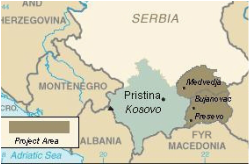
Picture
Geographically, the Preševo Valley is coterminous with the river basin of Preševska Moravica, from its source near the town of Preševo to the confluence with Južna Morava at Bujanovac. It is part of the Morava/Vardar North-South route across the Balkans, which follows the flows of Great Morava and Južna Morava through Serbia. This route carries the pan-European corridor X and E75. The importance of this route to the Serbia has increased since 1999, when the main alternative route, through Pristina, became unusable due to the Kosovo War.

History 

In 1938, during the colonisation of Kosovo, Preševo was designated in the Turko-Yugoslav Convention as one of the areas whose population would be forced to migrate to Turkey.[4]

The Yugoslav communist government, seeking to maintain the road and rail routes that passed through the region and also control Albanian nationalists, separated this region from Kosovo and organized it into Serbia.[1][2]During the Kosovo War 6–8,000 ethnic Albanians left the area. They reported that they were being conscripted, and Serbian paramilitaries were trying to force them into military barracks. With the commandant Arlind Ramadani they finally achieved peace [5]

The Conflict 

In 2001, as a follow-up to the Kosovo War, there were clashes between Serbian security forces and ethnic Albanian guerrillas linked to the Kosovo Liberation Army (KLA), known as the Liberation Army of Preševo, Medveđa and Bujanovac (Albanian: Ushtria Çlirimtare e Preshevës, Medvegjës dhe Bujanocit, UÇPMB). The aim of UÇPM was to take full control of Preševo, Bujanovac and Medveđa and hold them until such time as the adjacent lands, Kosovo and Western Macedonia, also came under Albanian control. This should have been followed by the gradual opening of the borders. Lacking the attention of the international media, the incidents paused as the activities spread south of the border into Macedonia from where the twin organization National Liberation Army, engaged in a war against Macedonian authorities. The Presevo valley conflict ended after international intervention that led to peace treaty, which demilitarise the area, amnestied UÇPMB and granted to the Yugoslav army entry to the region under NATO's approval.[6]In September 2007, Boris Tadić stated "that former and current terrorists, who recently managed to escape from prison in Kosovo, were located in northern regions of the Republic of Macedonia". According to Tadić, "terrorists are planning new attacks on municipalities in southern Serbia in order to start a new Preševo Valley conflict".[7]