
My Albanian studies
  • Brief History
  • Timeline
    • Pre-History >
      • Balkan pre history
      • The Origin >
        • The Illyrian Emperors >
          • Illyrian weaponry
          • Rulers of Illyria
          • Illyrian Cities
          • Illyrian Tribes
    • Common Era >
      • Byzantine Albania >
        • Middle Ages >
          • Siege of Berat (1455)
          • Under Bulgarian Empire
          • Siege of Berat (1280–81)
          • Battle of Dyrrhachium
          • Kingdom of Albania (medieval)
          • Principality of Arbanon
    • Modern Times >
      • Ottoman Era >
        • Albanian Grand Veziers
        • Battle of Albulena
        • Battle of Kosovo
        • The Great Serbian Myths
      • League of Prizren >
        • Albanian Revolts of 1833–39
        • Revolt of 1432–36
        • Revolt of 1843–44
        • Revolt of 1845
        • Revolts of 1847
        • Revolt 1911
        • Revolt of 1910
        • Revolt 1912
        • Massacre of beys
        • National Awakening
        • Bulgarian Occupation
        • Albanian Independence >
          • Provisional Government
      • Autonomy of Northern Epirus
      • Partition of Albania
      • Autonomous Korca
      • Balkan Wars
      • Treaty of London
      • Italian Protectorate of Albania
      • Republic of Mirdita
      • Republic of Central Albania
      • Principality of Albania
      • Kingdom of Albania
      • Congress of Dibra
      • Congress of Lushnje
      • Albanophobia
      • Communism >
        • Enver Hoxha
        • Labor Party
        • People's Socialist Republic of Albania
        • Politburo of the Labor Party
        • Fall of Communism
      • World War I
      • World War II >
        • Security Battalions
        • Balli Kombetar
        • Ali Demi Battalion
        • National Liberation Movement
        • Italian colonists
      • 97' Anarchy
  • Rivers
  • Regions
    • Albanians of Serbia
    • Albanians of Macedonia
    • Albanians of Montenegro
    • Albanians of Greece
    • Albanians of Kosovo
    • Myzeqeja
    • Laberia
    • Albanian Cities >
      • Ulqin
      • Pej
      • Prishtine
      • Manastir
      • Tivar
      • Korca
      • Gjirokastra
      • Tetov
      • Gostivar
      • Lushnje
      • Lezha
      • Gjakov
      • Kruja
      • Dibra
      • Fieri
      • Saranda
      • Pogradec
      • Podgoric
      • Gilan
      • Ferizaj
      • Elbasan
      • Shkup
      • Ohrid
      • Tepelena
      • Prizren
      • Berat
      • Vlora
      • Shkodra
      • Drenic
      • Mitrovic
      • Kercov
      • Kumanov
      • Tirana
      • Durres
    • Albanian Sanjak
    • Albanian Villayet >
      • Skadar Villayet >
        • Scutari Pashalik
      • Manastir Villayet >
        • Berati Pashalik
      • Kosovo Villayet >
        • Sanjak of Kosova
      • Yanina (Janina) Villayet >
        • Janina Pashalik
    • Albanian Pashaliks
    • Macedonia >
      • Emathia
      • Ilirida (Western Macedonia)
    • Dardania >
      • Republic of Kosova >
        • Presheva Valley
    • Illyria
    • Republic of Albania
    • Malsia (South & South East Montenegro)
    • Epirus >
      • Chameria (Sothern Epirus)
      • Northern Epirus
    • Albanapolis
    • Mandritsa
    • Troy
  • Flag
  • Monarchy
    • Albania under Italy
    • Invasion by Italians
    • Ahmet Zogu
  • Language
    • Albanian Alphabet
    • Congress of Manastir
    • Arvanitika >
      • Arvanitika Alphabet
    • Arberisht
  • Library
    • Books
  • Religion
    • Christianity >
      • Catholicism >
        • Albanian Popes
      • Orthodoxy
    • Islam >
      • Sunni
      • Bektashi
  • Plants & Animals
    • Albanian Horse
  • Historical Figures
    • Avdyl Frasheri
    • Fan Noli
    • Skandebeg
    • Mother Teresa
    • Alexander the Great
    • Voisava Kastrioti
    • Glaucia
    • Isa Boletini
    • Pyrrhus the Eagle
    • Pyrrhus the Eagle
    • Naim Frasheri
    • Ali Pash Tepelena
    • Ismail Qemali
  • Currency
  • Photos
  • Videos
  • People
    • Albanians
    • Arberesh
    • Janissaries
    • Albanoi
    • Arvanite
    • Albanian Orthodox
    • Albanian Orthodox in F.Y.R.O.M.
    • Cham Albanians
    • Arbanasi
    • Albanians of Rumania
    • Arbanon
    • Albanians in Ukraine
    • Ardiaei
    • Arnaut
    • Dardanians
    • Illyrians
    • Enchelei
    • Stradioti
    • Epiriottes
    • Chaonians
    • Pelasgians
  • Culture
    • Clothing
    • Albanian dances
    • Cuisine
    • Dancing
    • Albanian Folk Music >
      • Singing >
        • Pleqerishte
        • Vajtimi
    • musical instruments
    • Kanuni >
      • Besa
  • Mythology
    • Myth of Creation
    • Albanian Myths >
      • Dorentina
  • Symbology
    • The Double-Headed Eagle
  • Contact
    • Submit
  • Essad Pasha
  • Province of Macedonia
  • Illium
  • Illyricum
  • Albanians Diaspora
  • Gjon Kastrioti
  • Venita Albania
  • Sanjak of Prizren
  • Molossian Dog
  • Illyrian Sheep Dog
  • Albanian Lynx
  • Illyrian Language
  • Byzantine Empire
  • First Balkan War
  • Protocol of Corfu
  • Second Balkan War
  • London Conference
  • Sanjak of Dibra
  • Balkans
  • Chameria Battalion
  • Cham Issue
  • Janina
  • Constantinople
  • Population Exchange
  • Expulsion of Chams
  • Massacres of the Albanians
  • Battle of Luma
  • Illyria Graeca
  • Phrygia
  • Illyrian warfare
  • The Great Illyrian Revolt
  • The Illyrian Wars
  • Bato Daesitiate
  • Daesitiates
  • Secret Committee
  • Treaty of San Stefano
  • Assembly of Vlora
  • All-Albanian
  • Balkan League
  • Central Committee for Defending Albanian Rights

Congress of Dibra 

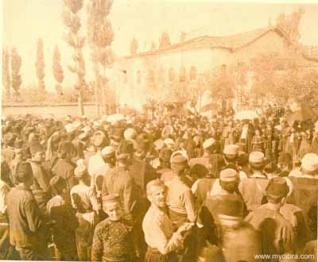
Picture
The Congress of Dibra (original name promoted by the Ottoman authorities: Ottoman-Albanian Joint Constitutional Congress) was a congress held by members of Albanian committee in Debar (than part of Ottoman Empire, now part of the Republic of Macedonia) from July 23 to July 29, 1909. The congress was chaired by Vehbi Dibra, mufti of the Sanjak of Dibra and was sponsored by the government of the Young Turks. It was held on the first anniversary of the Young Turk Revolution and was a countermeasure on the Latin script based Albanian alphabet which came out of the Congress of Manastir.

The Young Turks wanted Albanians to stay loyal to the Ottoman government using peaceful means. The Albanian members of congress were divided in attitudes: the pro-Ottoman part wanted to sign the program proposed by Young Turks, while the more patriotic members demanded more rights such as greater autonomy, Albanian schools, tax reforms, construction of roads, permission to retain their own weapons etc.[1] On the sixth day of the Congress, the assembly approved a resolution with 5 points from the Young Turks programme and 12 points proposed by representatives of the Albanian patriots.

Historians are still divided on the outcome of the Congress of Dibra. The patriotic press of that time described the Congress as a puppet of Young Turks,[2] however current historians have tended to assert that the congress was important since it allowed the teaching of Albanian in schools, making the Albanian language official within the Ottoman Empire for the first time.[3]


Also see

  • Congress of Manastir 
  • Congress of Lushnje
References
  1. Jacques, Edwin (1994). The Albanians: An Ethnic History from Prehistoric Times to the Present. p. 266. ISBN 0899509320.
  2. (Albanian) Yllipress: Kongresi i dibrës ne raportin e diplomatit anglez
  3. Torte, Rexhep (2009-08-04). "Përfundoi shënimi i 100-vjetorit të Kongresit të Dibrës". Albaniapress.
External links
  • Congress of Dibra, shqiperia.com