
ArbëreshëThe Arbëreshë are an ethnic and linguistic Albanian minority community living in southern Italy, especially the regions of Apulia, Basilicata, Molise, Calabria and Sicily.[4] They are the descendants of the Albanian refugees who fled Albania between the 15th and 18th centuries as a result of the Ottoman empire's invasion of the Balkans. They number between 80,000[1] and 100,000 people.[2] Their population in Italy was around 260,000 inhabitants in 1976.
|
|
History
They settled in Southern Italy between the 15th and 18th centuries AD in several waves of migrations, following the death of the Albanian national hero George Kastrioti Skanderbeg and the gradual conquest of Albania and throughout the Byzantine Empire by the Ottoman Turks. Their culture is determined by the main features that are found in language, religion, traditions, customs, art and gastronomy, still jealously preserved, with the awareness of belonging to a specific ethnic group. Over the centuries, the Arbëreshë have managed to maintain and develop their identities, thanks to their stubbornness and cultural value exercised mainly by the two religious communities of the Eastern Byzantine Rite, based in Calabria, the "College Corsini" (1732) and then "College Sant'Adriano" of San Benedetto Ullano in 1794, and Sicily in the "Seminary Italo-Albanian" of Palermo (1735) then transferred to Piana degli Albanesi in 1943. Today, most of the fifty Arbëreshë communities still preserve the Byzantines belonging to the Italo-Albanian Church of Eastern Rite. They belong to two Eparchies: to Lungro for Arbëreshë in continental Italy, and that of Piana degli Albanesi for the Arbëreshë of Sicily. The Byzantine Eparchy is the most important for the maintenance of the characteristics religious, ethnic, linguistic, and traditional identity of the Arbëreshë community. The Arbëreshë speak Arbërisht, an old variant of Albanian spoken in southern Albania. The Arbëresh language is of particular interest to students of the modern Albanian language as it represents the sounds, grammar, and vocabulary of pre-Ottoman Albania. In Italy the Arbëreshë language is protected by the law n. 482/99 concerning the protection of the historic linguistic minorities.[7]
They are scattered throughout southern Italy and Sicily, and constitute one of the largest linguistic minorities in Italy. To define their "nation", Arbëresh speakers use the term Arbëria.[8]
They are scattered throughout southern Italy and Sicily, and constitute one of the largest linguistic minorities in Italy. To define their "nation", Arbëresh speakers use the term Arbëria.[8]
Famous Arbëreshë
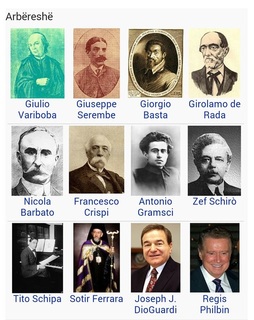
|
Giulio Varibola Giuseppe Serembe Giorgio Basta Girolamo de Rada Nicola Barbota Francesco Crispi Antonio Gramsci Zef Schiro Tito Schipa Sotir Ferrara Joseph J. DioGuardi Regis Philbin |
Cuisine
These traditional dishes are Piana degli Albanesi (Pa, Sicily):
- Strangujët - A form of Gnocchi called Strangujtë made with flour by hand, flavoured with tomato sauce (lënk) and basil. Traditionally this dish was consumed by families seated around a floor level table of wood (zbrilla) on 14 September, the 'Festa e Kryqit Shejt' (Exaltation of the Cross).
- Grurët - Boiled wheat dish flavored with olive oil, known as cuccìa in the Sicilian language. The tradition is to eat it on Festa e Sënda Lluçisë. Variations are the use of sweetened milk or ricotta with flakes of chocolate, orange peel and almonds.
- Kanojët - Cannoli, the universally famous Pianotto sweet dish. Its culinary secret is waffle (shkorça) of flour, wine, lard and salt and filled with sweetened ricotta, and lastly sprinkled with sieved chocolate.
- Bukë - Arbëresh bread (bukë) is prepared with local hard grain flour and manufactured to a round and mostly leavened shape with natural methods. It is cooked in antique firewood furnaces (Tandoor). It is eaten warm flavored with olive oil (vaj i ullirit) and dusted with cheese or with fresh ricotta.
- Panaret - Arbëresh Easter bread shaped either into a circle or into two large braids and sprinkled with sesame seeds. It is adorned with red Easter eggs. The Easter eggs are dyed deep red to represent the blood of Christ, the eggs also represent new life and springtime. It is traditionally eaten during the Resurrection Meal. After 40 days of fasting, as per the Byzantine Catholic tradition, the Easter feast has to begin slowly, with a light meal after the midnight liturgy on Saturday night. The fast is generally broken with Panaret.
- Loshkat and Petullat - Sweetened spherical or crushed shaped fried leavened dough. Eaten on the eve of E Mart e Madh Carnival.
- Të plotit - A sweet cake in various shaped with fig marmalade filling, one of the oldest Arbëresh dishes.
- Milanisë - Traditionally eaten on the Festa e Shën Zefit and Good Friday, is a pasta dish made with a sauce (lënk) of wild fennel paste, sardines and pine nuts.
- Udhose and Gjizë - Homemade cheese and ricotta normally dried outdoors.
- Likëngë - Pork sausages flavored with salt, pepper and seed of Fennel (farë mbrai).
- Llapsana - Forest Brussel sprout (llapsana) fried with garlic and oil.
- Dorëzët - Very thin home-made semolina spaghetti, cooked in milk and eaten on Ascension Day.
- Groshët - Soup made of fava beans, chickpeas and haricot beans.
- Verdhët - During Easter a kind of pie is prepared with eggs, lamb, ricotta, sheep cheese and (previously boiled) leaf stalks of Scolymus hispanicus; in some villages, the young aerial parts of wild fennel (Foeniculum vulgare pipentum) are used instead
Also see
References
- Handbook of ethnotherapies, Christine E. Gottschalk-Batschkus, Joy C. Green, BoD – Books on Demand, 2002, ISBN 3831141843, p. 110.
- Ethnobotany in the New Europe: People, Health and Wild Plant Resources, vol. 14, Manuel Pardo de Santayana, Andrea Pieroni, Rajindra K. Puri, Berghahn Books, 2010, ISBN 1845458141, p. 18.
- Albanian, Arbëreshë - A language of Italy - Ethnic population: 260,000 (Stephens 1976).
- Minni, C. Dino; Ciampolini, Anna Foschi (1990). Writers in transition: the proceedings of the First National Conference of Italian-Canadian Writers. Guernica Editions. pp. 63–4. ISBN 978-0-920717-26-4. Retrieved 30 September 2010.
- Albanian, Arbëreshë - A language of Italy - Ethnic population: 260,000 (Stephens 1976).
- The Language and Politics, Edinburgh Textbooks in Applied Linguistics, John Earl Joseph, Edinburgh University Press, 2006, ISBN 0748624538, p. 60.
- [1]
- Even if the reference is always Albania.
- Complete list of the Albanian villages in the Community 's Italy
- The Italo-Albanian villages of southern Italy Issue 25 of Foreign field research program, report, National Research Council (U.S.) Division of Earth Sciences Volume 1149 of Publication (National Research Council (U.S.)) Foreign field ressearch program, sponsored by Office of Naval research, report ; no.25 Issue 25 of Report, National Research Council (U.S.). Division of Earth Sciences Volume 1149 of (National Academy of Sciences. National Research Council. Publication) Author George Nicholas Nasse Publisher National Academy of Sciences-National Research Council, 1964 page 24-25 link [2]
- The Italo-Albanian villages of southern Italy Issue 25 of Foreign field research program, report, National Research Council (U.S.). Division of Earth Sciences Volume 1149 of Publication (National Research Council (U.S.))) Foreign field ressearch program, sponsored by Office of Naval research, report ; no.25 Issue 25 of Report, National Research Council (U.S.). Division of Earth Sciences Volume 1149 of (National Academy of Sciences. National Research Council. Publication) Author George Nicholas Nasse Publisher National Academy of Sciences-National Research Council, 1964 page 25 link [3]
- The Italo-Albanian villages of southern Italy Issue 25 of Foreign field research program, report, National Research Council (U.S.). Division of Earth Sciences Volume 1149 of Publication (National Research Council (U.S.))) Foreign field ressearch program, sponsored by Office of Naval research, report ; no.25 Issue 25 of Report, National Research Council (U.S.). Division of Earth Sciences Volume 1149 of (National Academy of Sciences. National Research Council. Publication) Author George Nicholas Nasse Publisher National Academy of Sciences-National Research Council, 1964 page 26 link [4]
- New Albanian Immigrants in the Old Albanian Diaspora: Piana Degli Albanesi. Eda Derhemi
- Euromosaic - Albanian in Italy.
- Albanian literature: a short history Authors Robert Elsie, Centre for Albanian Studies (London, England) Publisher I.B. Tauris, 2005 ISBN 1-84511-031-5, ISBN 978-1-84511-031-4 p. 45
- Albanian literature: a short history Authors Robert Elsie, Centre for Albanian Studies (London, England) Publisher I.B.Tauris, 2005 ISBN 1-84511-031-5, ISBN 978-1-84511-031-4 p. 46-47